How it is done now
Status arrives through standup and Slack, and incidents surface after they are already closed.
A meeting to learn what broke
Why it stalls
Activity is easy to count and waiting time is not, so the place work actually sits stays invisible.
No waiting-time number
With CloudThinker
One roll-up shows what the agents cleared, what escalated, and what is blocked on a person and for how long.
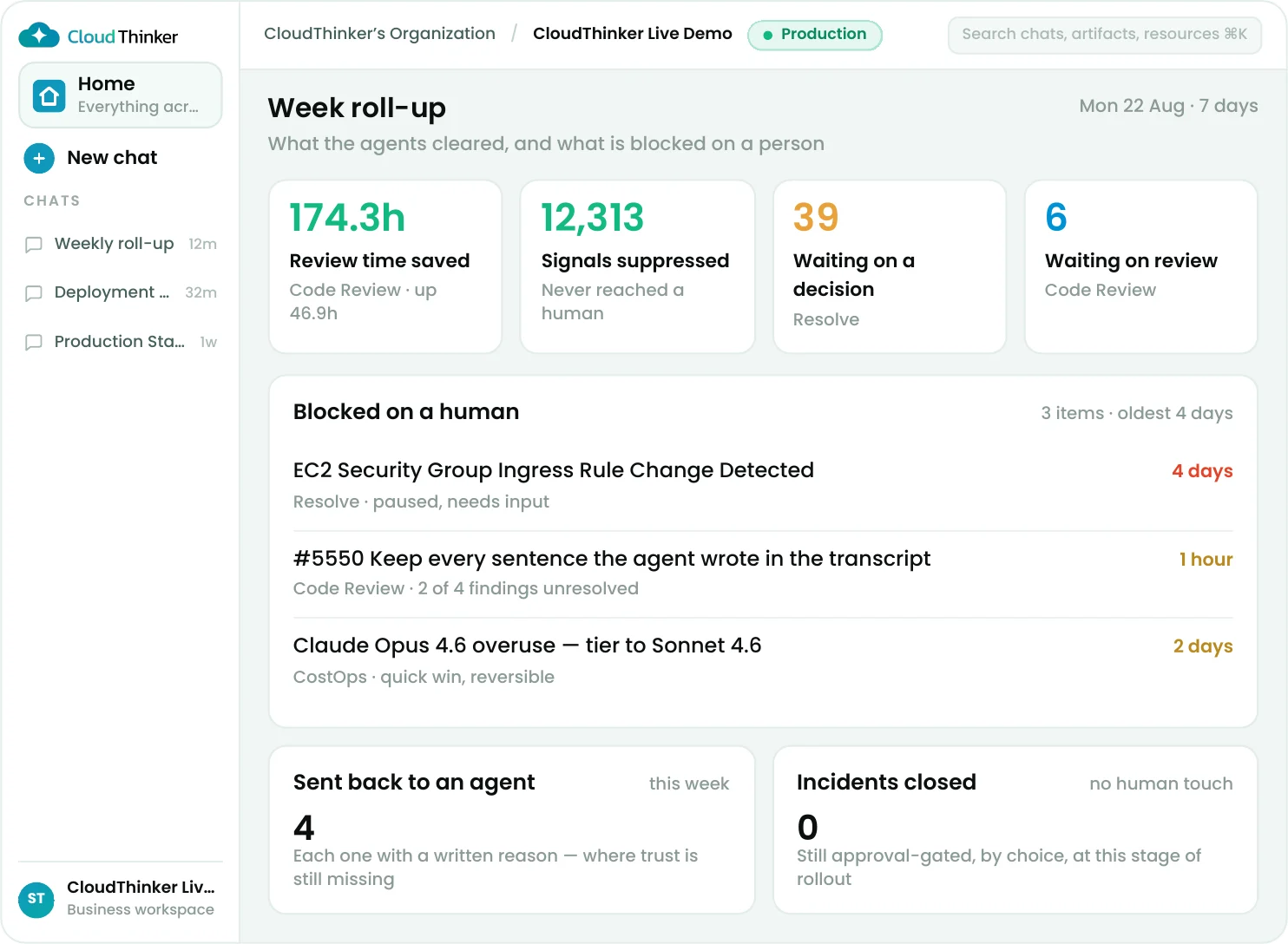
39 decisions, 6 reviews waiting
Morning
Read the roll-up: what the agents did, what they escalated, and what waits on a person.
In flow
Clear the escalations. That is the one queue that needs a manager in it.
End of day
Look at what the team sent back to an agent, and why. That shows where trust is still missing.
Waiting time
How long work sat idle waiting for a person to look at it.
Repeat work
Anything a person did twice that an agent could have owned.
Which changes this week were blocked waiting on human review, and for how long?
Common mistake
Measuring agent volume. Measure what a person still had to do twice.
What to expect
Standup stops being a status meeting and becomes a decision meeting.
How to read a week in two numbers
Read a weekly roll-up in two halves: what the agents cleared, and what is blocked on a person. The sample below covers one week.
01
Read the waiting numbers first. Most of that queue is not yours to answer, but all of it is yours to route.
02
Track how long items wait rather than how much the agents did. Waiting time is the measure that shows whether this works.
03
Read what the team sent back and why. Those reasons show where trust is still missing.