How it is done now
Scripts live in a repo and runbooks in a wiki, both owned by whoever happened to write them.
3 environments, fixed by hand
Why it stalls
Nothing runs on its own, so the work happens only when the person who remembers it has time.
Runs when someone is free
With CloudThinker
Automation runs them on a schedule or a trigger, each with an owner, a scope and an approval step.
41 runs, 0 failed
Morning
Check last night’s runs: what passed, what waits on approval, and what failed and why.
In flow
Anything the team did twice becomes an automation, with an owner, a scope and an approval step.
End of day
Retire automations that stopped earning their keep. An unused automation is a liability.
Automation
Runs scheduled and triggered runbooks, with approvals and an audit trail.
Resolve
Surfaces the incident that should have been an automation.
Turn this runbook into an automation with an approval step before anything writes.
Common mistake
Automating what you cannot explain. An automation nobody understands is a scheduled outage.
What to expect
Repeated work gets an owner, a schedule and a log.
How an automation earns its place
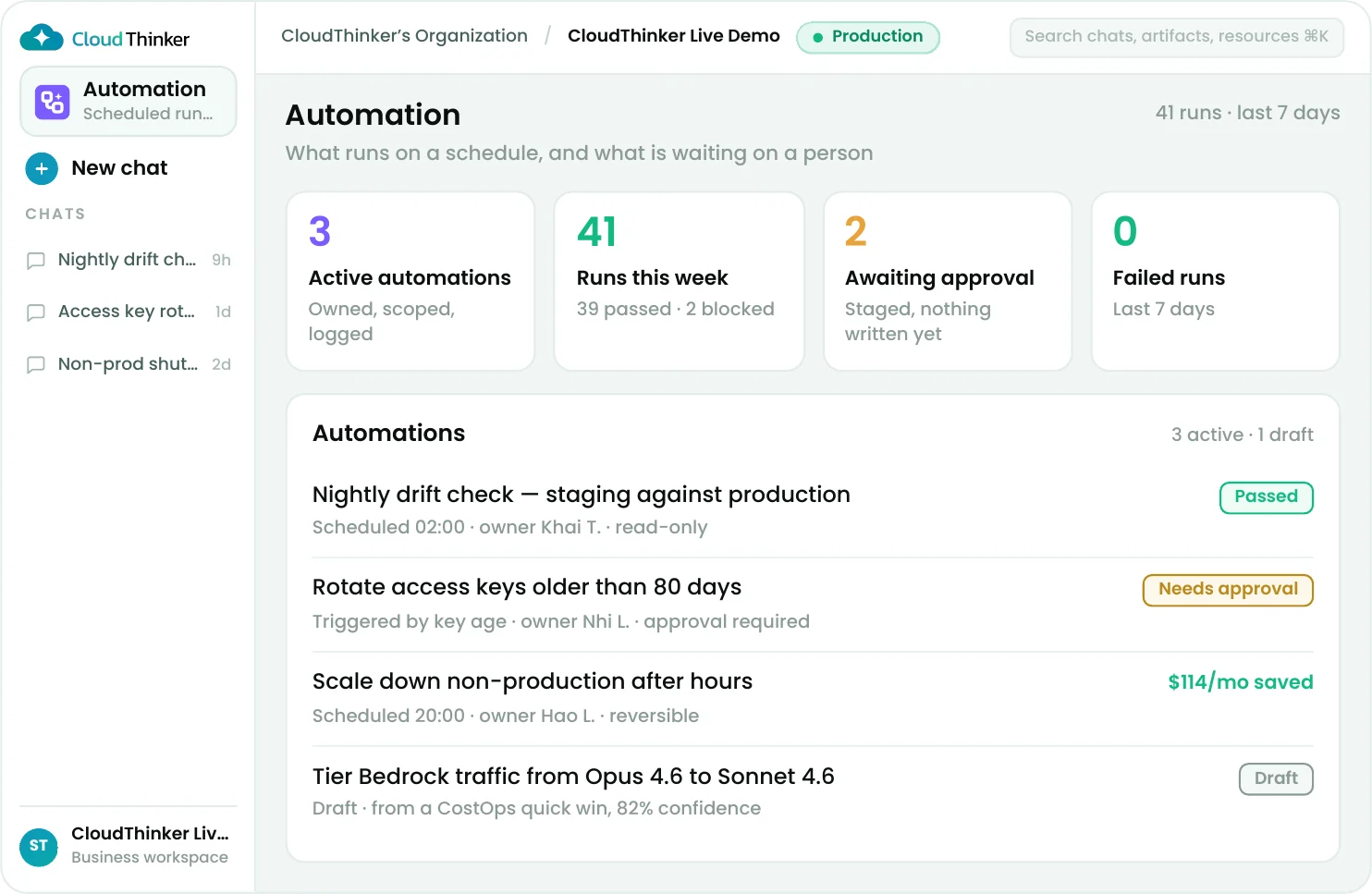
Read an automation list by ownership and scope rather than by count. The sample below shows three active and one draft.
01
Require an owner and a scope on every automation. Unowned automation is the risk, not the work it performs.
02
Prefer runs that pause for approval over runs that fail quietly. Early on, nothing should write to production unattended.
03
Promote automations out of findings that recurred. A task earns a schedule once it has happened twice.