
Your On-Call Has Not Met Astra Yet
One fault in SREGym installs a mutating admission webhook that quietly sets bad resource limits on new pods. The pods fail. The obvious suspect is the pod, because that's what's failing. In our September campaign, five models missed this fault, and all five named the same victim pod. GPT-6 Astra, running inside Resolve, named the webhook.
That gap is what this post measures. Two agents can restore service on the same fault while only one of them knows why, and the one that knows why is the one you want on call. A single leaderboard row won't tell you which you have.
Below are two sets of numbers, kept apart on purpose.
- On the public leaderboard. When we checked the SREGym-Lite leaderboard on November 2, 2026 (17 faults), CloudThinker with GPT-6 Astra (low) scored 100% end to end with 736K tokens per run. Three agents were at 100%: Radar + Claude Code ranked first with 554K tokens, Devin Oncall second with 1.24M, and CloudThinker third. With the same model, Claude Opus 5, CloudThinker scored 76.5 versus 70.6 for Claude Code.
- In our own campaign. We ran seven models inside Resolve on 21 faults. With Astra, Resolve diagnosed 21 of 21 and resolved 20 of 20 gradable faults end to end. With Claude Opus 5 it resolved 18 of 20. Model choice alone moved the resolution rate from 40% to 100%. Astra cost $3.53 per resolved fault against $9.53 for Opus 5, and the Astra figure is a floor.
01Public leaderboard
17 faults
Third-party submissions verified by the SREGym team. Checked November 2, 2026.
02Our own campaign
21 faults, 20 gradable
Seven models inside Resolve, one cold run each. Run in September 2026.
The two sets use different faults, different runs and different counting rules. We never compare a number from one with a number from the other, and you shouldn't either.
Why one leaderboard row doesn't pick a model
The obvious way to choose a model for an incident agent is to read the leaderboard, take the top row and check the token price. That breaks down for structural reasons.
- A row measures a model inside someone's harness. On the public leaderboard, Claude Opus 5 scores 70.6 end to end inside Claude Code and 76.5 inside CloudThinker. Same weights, different tools, verification pass and prompt, different score.
- Token price isn't the cost of an incident. You pay for a resolved fault. A model that's cheap per token but fails half the time, or reads twice the context to get there, costs more per fix.
- Diagnosis and mitigation are different skills. A model can restore service while naming the wrong component. The scoreboard may forgive that. The postmortem won't.
- The benchmark has its own defects. One fault in our cohort can't be mitigated by anyone, because of the grader. Unless you read the source, it looks like every model's failure.
So in our own campaign we held the harness fixed and changed only the model.
How SREGym grades
SREGym is a live benchmark for SRE agents from the University of Illinois and the University of Toronto. It deploys a real application on a Kubernetes cluster, injects one fault, and grades the agent in two stages.
- Diagnosis. An LLM judge reads the agent's write-up against a checklist. It passes only if the agent named the faulty component and characterised the fault correctly.
- Mitigation. A problem-specific oracle checks the live cluster. It passes only if the application actually works again.
01Inject
One fault
A real app on Kubernetes, one fault, one cold run.
02Diagnose
LLM judge
Passes only if the write-up names the faulty component and the fault.
03Mitigate
Oracle
Passes only if the live cluster actually works again.
04Score
End to end
Both stages must pass on the same run.
End to end is the intersection: both stages pass on the same run. An agent can name the cause and fail to fix it, or fix it while naming the wrong thing. Both happen.
The public leaderboard
Values as we checked them on November 2, 2026, on the SREGym leaderboard, SREGym-Lite cohort, 17 faults. The board moves as new agents submit, so check it for current ranks.
| Rank | Agent | Model | End to end % | Tokens per run |
|---|---|---|---|---|
| 1 | Radar + Claude Code | Claude Opus 5.5 (medium) | 100.0 | 554K |
| 2 | Devin Oncall | Claude Opus 5.5 (high) | 100.0 | 1.24M |
| 3 | CloudThinker | GPT-6 Astra (low) | 100.0 | 736K |
Same model, two harnesses:
| Agent | Model | End to end % |
|---|---|---|
| CloudThinker | Claude Opus 5 | 76.5 |
| Claude Code | Claude Opus 5 | 70.6 |
At the top, three agents close every fault, so the board separates them on speed and cost. CloudThinker used fewer tokens than Devin Oncall (736K against 1.24M) and more than Radar + Claude Code (554K). Further down, the harness shows on its own: with the same Opus 5 weights, CloudThinker scores about six points higher than Claude Code.
Our own campaign: seven models, one harness
The leaderboard shows one row per submission. To choose a model, we needed every model on the same harness, so we ran our own campaign. These rows are self-run. They aren't leaderboard submissions, and they use a different fault set.
We ran the SREGym-Lite-0904 cohort (21 faults across four applications, SREGym commit f125857) on our own infrastructure with our benchmark kit 1.7.0, in September 2026. Same contract for every model: one cold run per fault, no memory carried between faults, noise injection off, prompt mode fixed, and diagnosis judged by Claude Sonnet 4.6 as in the SREGym paper.
One fault no model can close
One of the 21, duplicate_pvc_mounts_social_network, has a mitigation check that can't pass. We read the benchmark source to find out why. The benchmark's own observer replaces the tracing service with an ExternalName service, and Kubernetes never creates Endpoints for that kind of service. The mitigation oracle reads the Endpoints of the tracing service and fails with a 404 before it looks at the cluster, whatever the agent did.
No model passed this mitigation in our ledger, across 22 runs and eight models. Astra diagnosed it correctly twice, fixed the workload to two ready replicas, and still scored a fail. So we void that one stage. Diagnosis on that fault still counts, because the judge can grade it. Mitigation and end to end don't, because the oracle can't. Every campaign number below uses 21 faults for diagnosis and 20 for mitigation and end to end.
The results
| Model | Diag. % | Mit. % | E2E % | 95% CI | TTM s | Tokens / run | Cost per resolved fault |
|---|---|---|---|---|---|---|---|
| GPT-6 Astra (low) | 100 | 100 | 100 | 84 to 100 | 335 | 2.13M | $3.53 |
| Claude Opus 5 (high) | 95.2 | 90.0 | 90.0 | 70 to 97 | 1283 | 1.93M | $9.53 |
| GPT-5.6 Sol (high) | 85.7 | 75.0 | 65.0 | 43 to 82 | 890 | 1.75M | $12.19 |
| GLM-5.3 (low) | 71.4 | 70.0 | 60.0 | 39 to 78 | 1017 | 3.45M | $1.52 |
| GPT-5.6 Luna (max) | 76.2 | 75.0 | 60.0 | 39 to 78 | 1278 | pending | $1.83 |
| Claude Sonnet 5 (high) | 52.4 | 60.0 | 45.0 | 26 to 66 | 1262 | 6.22M | $5.17 |
| DeepSeek V4 Flash (low) | 57.1 | 60.0 | 40.0 | 22 to 61 | 1097 | pending | $0.11 |
Cost is what we were billed, divided by the faults that model resolved. Astra, Opus 5, Sol and Sonnet 5 ran on three parallel lanes and the other three on five, so compare times only within the same group. The Astra and DeepSeek prices are floors, because 10% and 19% of their tokens weren't priced. The Luna price is recomputed from token counts at list rates, because our tracing stopped pricing that model mid-campaign. Over all 21 faults with nothing voided, Astra closes 95.2% end to end and Opus 5 closes 85.7%.
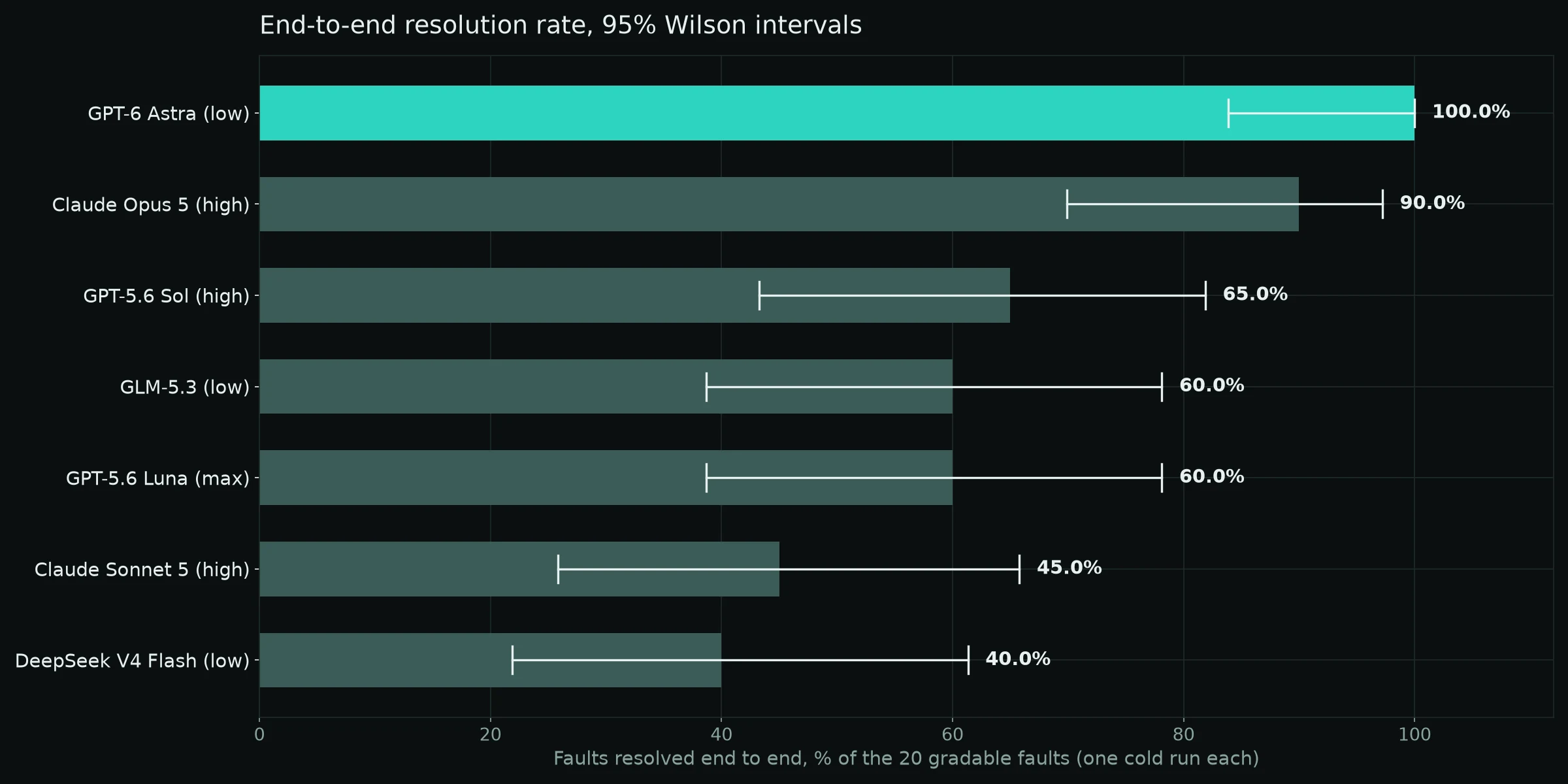
Every confidence interval overlaps its neighbour. With 20 faults and one run each, Astra separates at 95% confidence from five of the six other models, and Opus 5 separates from two. Neither separates from the other. Read the table as "Astra and Opus 5, then a pack", not as a ranking.
What the campaign says that a leaderboard row can't
01Outcome
40% to 100%
End-to-end resolution across seven models inside one harness.
02Cost
Per resolution
Price per attempt rewards models that fail fast.
03Coupling
Name it, fix it
Only Astra and Opus 5 never patched a component they could not name.
04Tokens
More is not better
Of the five we could count, the three lightest spenders resolved the most.
Cost per resolved fault is the number that matters. Cost per fault attempted rewards a model that fails fast. Astra resolves two more faults than Opus 5 at 37% of the cost per resolution. Sol costs more per resolution than either and resolves five fewer faults than Opus 5. GLM-5.3 reaches two thirds of the Opus 5 outcome at one sixth of the price, with a fatter latency tail.
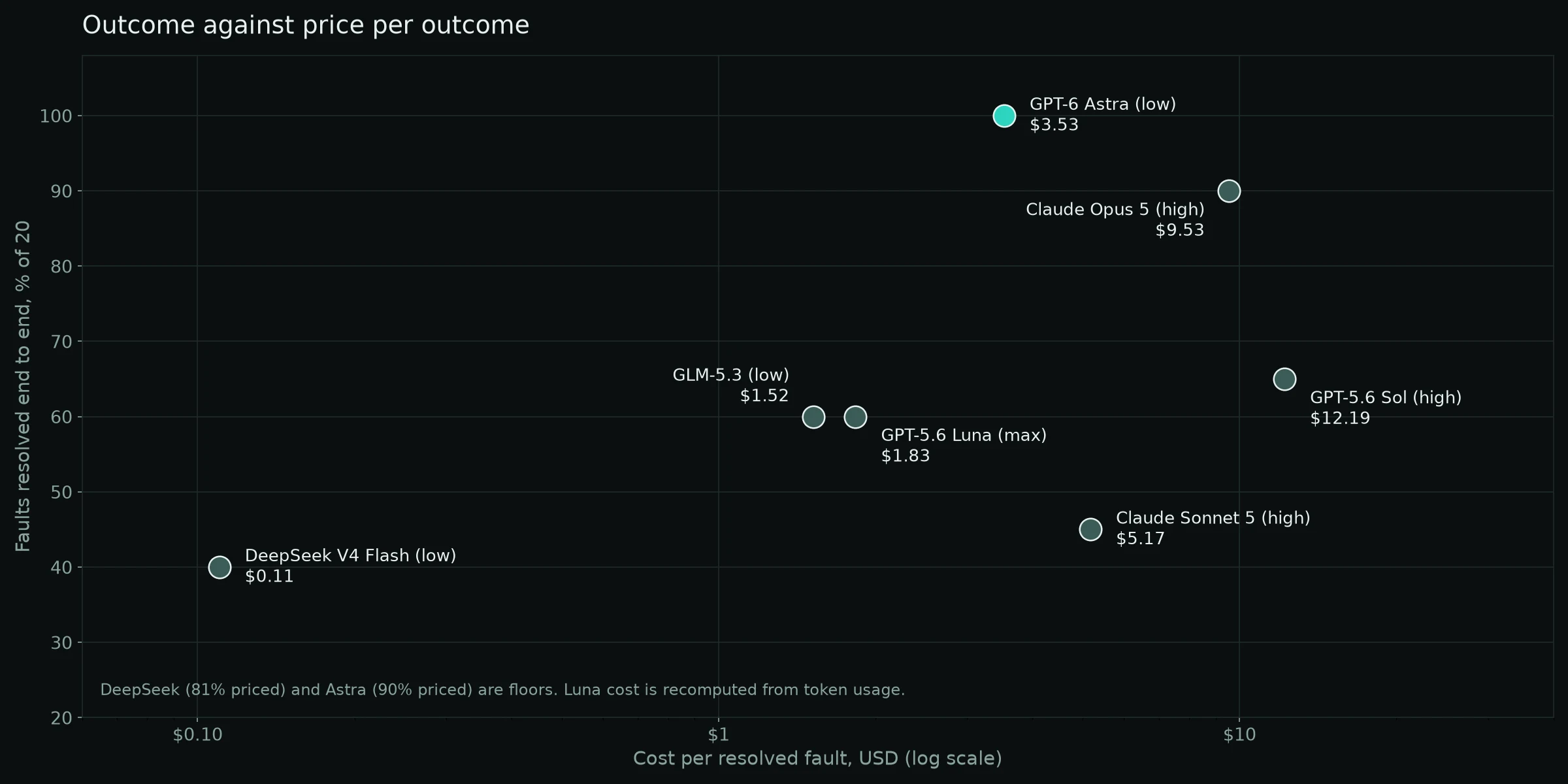
More tokens didn't buy accuracy. Of the five models whose tokens we could count, the three that spent the least per run (Sol, Opus 5 and Astra) resolved the most. Sonnet 5, at 6.22M per run, came sixth. Sonnet 5 and DeepSeek also spent more tokens on the runs they failed than on the runs they resolved. A model that burns context while losing is lost, not working harder.
Diagnosis and mitigation are separate skills. Luna ties for third on mitigation and sits fourth on diagnosis. Six of its runs restored the service while the write-up named the wrong component. That's an operational risk, not a scoring artifact: an engineer reading that postmortem learns the wrong lesson, and the next incident starts from it. Astra and Opus 5 had zero such runs. Every other model did it between two and six times. The only points Astra dropped were on scope: twice it named a slightly wider blast radius than the ground truth, and the judge passed both.
Failures cluster by fault, not by model. The mutating-webhook fault from the opening is the clearest case. Four other faults broke every earlier model: stale rotated secrets, a retry collapse under search load, an unschedulable port assignment and a misconfigured rolling update. All four passed on Astra's first run. The fault type decides how a failure looks. The model decides whether it happens.
Speed belongs to the model. On the same harness, with the same verification pass and the same approval gates, Astra reached mitigation in 335 seconds and Opus 5 in 1,283. Part of that is how we measure: our time to diagnose includes the judge's grading time, and our time to mitigate includes the time to diagnose. The rest is the model's pace.
The campaign also caught a flaw in our own harness. Our diagnosis prompt told models to treat tracing as out of scope. Astra diagnosed the tracing fault anyway. The others didn't, so we're changing the prompt.
What we're not claiming
- We're not first on the public leaderboard. When we checked on November 2, 2026, three agents were at 100% end to end: Radar + Claude Code ranked first, Devin Oncall second and CloudThinker third. The board changes as agents submit.
- The campaign isn't the leaderboard. It uses 21 faults, not 17, run on our own infrastructure. None of its numbers should be read against a leaderboard row.
- Our campaign denominators are 20, not 21, for mitigation and end to end, because we void one fault whose check can't pass. The undiscounted figures are above.
- One run per fault. A clean sweep on one run carries a wide interval. Astra's runs from 84 to 100.
- Same judge model, two routes. The Astra run reached Claude Sonnet 4.6 through a different provider route than the other six models.
- Noise injection was off. Runs with noise on face a harder condition.
- Sonnet 5 is understated. Several of its runs were lost to failures in our stack, not to the model. Its true rate is higher by an amount we didn't measure.
The full internal report, the per-fault grid for all seven models and the ledger behind every campaign number are available on request.
Getting started
You don't need 21 faults to learn something. Pick three incidents whose root causes you already know. Run each one through your incident agent, on two models if your setup lets you switch:
"Investigate the incident from last Tuesday's database failover and tell me the root cause, the evidence, and what you ruled out."
"Show me which component you'd change to fix this, and why that component and not its neighbours."
Then compare against your postmortems. Check whether each model named the right component, and whether the fix it proposed targets that same component. That second check is the one leaderboards skip, and it's the one that decides what your team learns.
Connect a source and ask your first question in Resolve.