How an Australian Telematics Provider Automates Day-to-Day Operations with CloudThinker
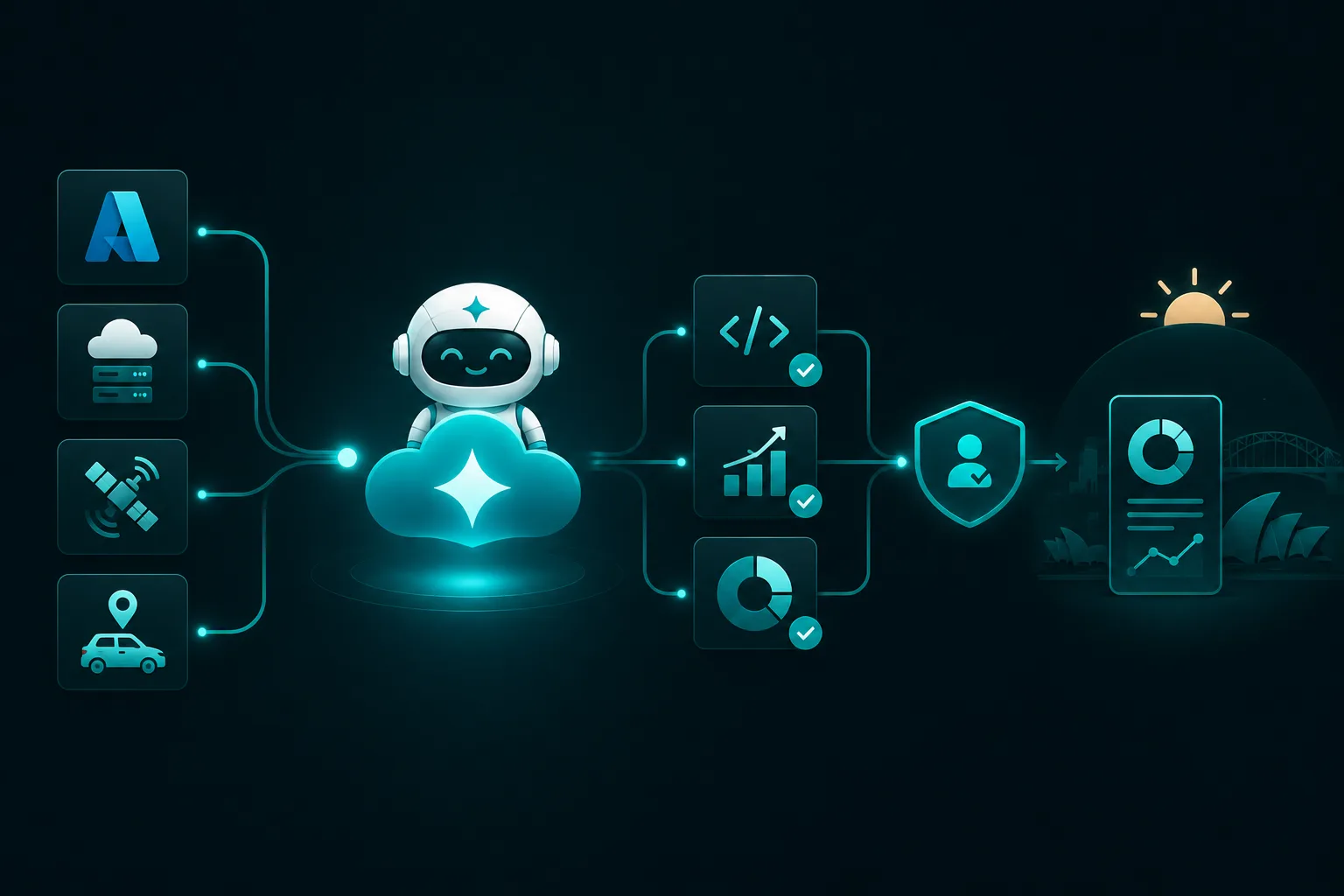
At 7 a.m. Sydney time, before the first engineer begins work, the day's operational report has already been produced. It covers the Azure subscriptions, the application platform running on them, and a fleet of GPS tracking devices reporting in from vehicles across the country. On a nominal morning, it is a brief summary confirming the estate is healthy. When something has changed overnight, the anomaly arrives already correlated, with a proposed next action attached.
The company behind that report is an Australian telematics provider — it builds and operates GPS tracking and fleet-monitoring systems, referred to here as the operator. In this post, we describe the operational challenges characteristic of the telematics industry, and how the operator addresses them with CloudThinker: consistent code review on every pull request, continuous cost optimization with CostOps, and a daily health check spanning cloud, platform, and device fleet — with human approval retained on every production-affecting action.
The operations challenge in telematics
Telematics is an unforgiving industry to operate in. Customers depend on the platform for real-time visibility of their vehicles and assets, so availability expectations are continuous. The services that ingest device messages are exposed to untrusted, device-originated input, making them a standing security surface. Unit economics are measured per tracked device, which turns cloud cost directly into margin. And the engineering organizations carrying all of this are typically lean: the same team ships product code, administers the cloud, and answers for the fleet.
For the operator, this translated into three recurring costs:
- Review depth varied with availability. Code review — including on security-sensitive ingestion services — depended on which senior engineer had time that week.
- Cloud cost accumulated silently. Compute sized for earlier traffic profiles, storage that never moved to lower-cost tiers, and resources left behind by completed projects eroded per-device margin between periodic cleanup efforts.
- Daily assurance was manual. The first hour of each working day was spent verifying the estate by hand: the Azure portal, the platform dashboards, the fleet's connection counts.
The operator's requirement was precise: delegate the mechanical portion of each responsibility, and keep a human decision in the path of anything that touches production.
Solution overview
CloudThinker connects to the operator's repositories, Azure subscriptions, IoT platform, and team chat through CloudThinker Connections — over each system's native API, with no software installed inside the estate. Every action executes inside Sandbox Isolation, is governed by the Guardrails Engine, and operates under the graduated autonomy of Auto Mode.
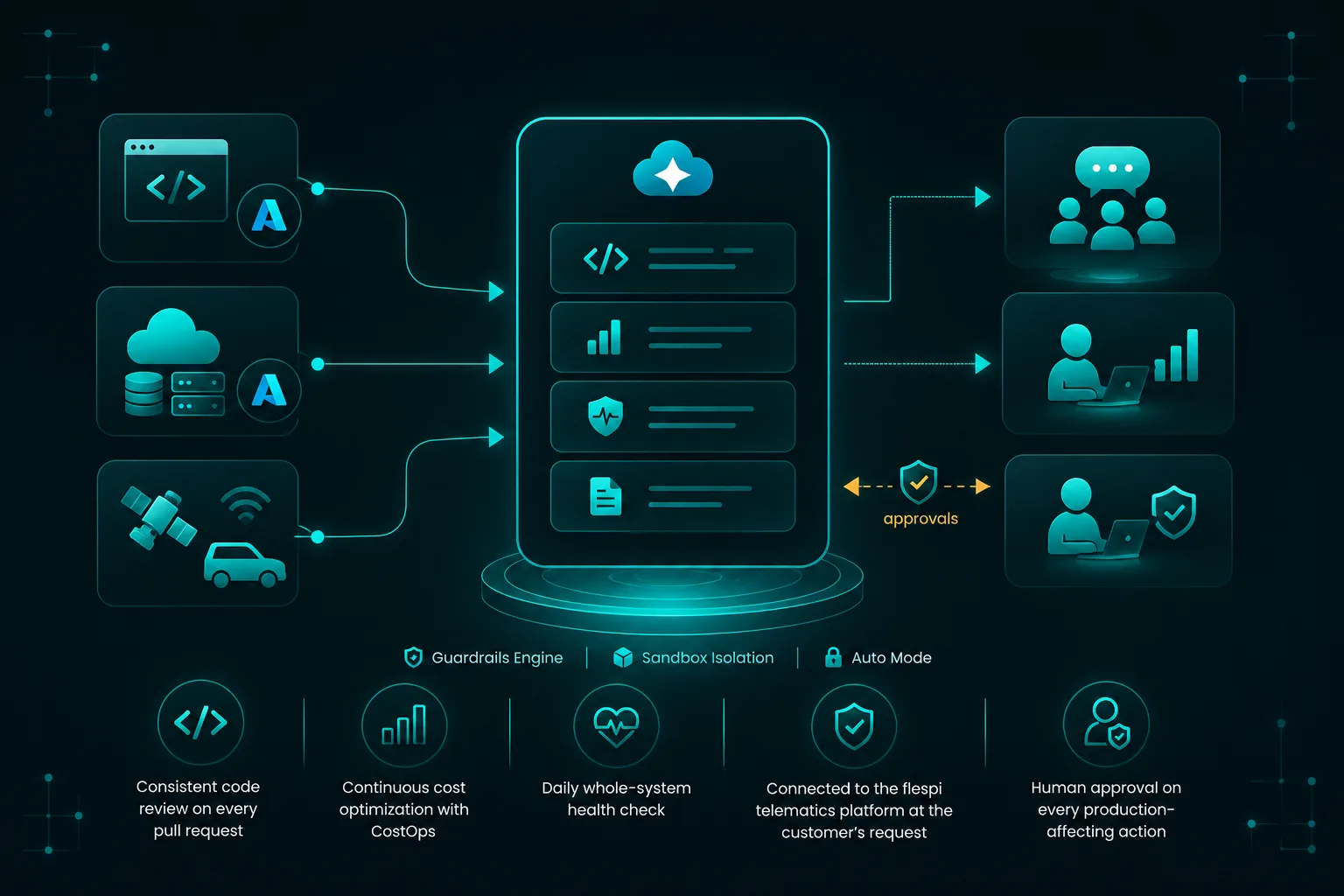
CloudThinker sits between the operator's repositories, Azure subscriptions, and platform and IoT telemetry on one side, and the team's chat workspace on the other. Consistent code review on every pull request, continuous cost optimization with CostOps, a daily whole-system health check, connection to the flespi telematics platform at the customer's request, and human approval on every production-affecting action all flow through the Guardrails Engine, Sandbox Isolation, and Auto Mode before reaching engineers for approval.
Three capabilities carry the operational load, each mapped to one of the industry pressures above: code review at the pull request, cost optimization as a continuous stream of proposals, and the scheduled health check that opens this post.
Consistent code review on every pull request
With AI Code Review, every pull request receives the same first-pass analysis before a human reviewer is assigned. Each diff is evaluated against the operator's own engineering conventions — error handling, logging, test coverage — curated by its senior engineers rather than drawn from a generic rule set. Security findings are reported with supporting reasoning: injection risks, committed credentials, authorization gaps, and unsafe handling of device-originated input, the category of defect that matters most on a telematics ingestion path.
The human reviewer retains ownership of the merge decision. What changes is the input to that decision: an annotated pull request with routine findings already identified, applied uniformly regardless of team workload or time of submission. Senior engineering time is redirected toward design and architectural review.
Continuous cost optimization with CostOps
In a per-device business, cost governance cannot be a quarterly project. CostOps evaluates the Azure estate continuously and submits findings as discrete, reviewable proposals: a resize supported by sustained utilization data, an idle resource with the evidence of its idleness attached, a stable workload identified as a candidate for reserved capacity — with variable workloads explicitly excluded.
Each proposal is delivered to the team's chat workspace with its supporting data, where it is approved, amended, or declined. Approved changes are applied through the same approval-gated execution path as every other action; no recommendation is actioned by hand in the Azure portal.
"Which of our Azure resources have been idle for the last 30 days? Propose what to shut down or downsize, and attach the utilization evidence for each one."
A daily health check across cloud, platform, and fleet
The scheduled check runs ahead of business hours and covers all three layers: the Azure layer (resource health, quota headroom, certificate and secret expiry, backup status), the platform layer (service availability, error rates, queue depths), and the device fleet (connectivity, channel health, message throughput and backlogs). The output is a single report in the operations channel. When an anomaly is detected, the responding engineer begins from a working hypothesis — symptom, affected layer, most plausible contributing change, proposed action — rather than from raw dashboards.
The same reporting program extends upward through the organization: a weekly summary of cost movement and review findings for the team, and a monthly estate-level view for management. None of these reports are assembled manually.
"Run the health check now — Azure, the platform services, and the device fleet. Post the summary to the ops channel and flag anything that needs a human today."
Extending coverage to the device platform
One requirement of this deployment came directly from the customer, and it is characteristic of the industry. The operator's devices do not communicate with Azure directly — they communicate with flespi, the telematics platform that manages device channels, message parsing, and stream delivery. An operations capability that stopped at the cloud boundary would observe only part of any fleet-related incident.
At the operator's request, CloudThinker Connections integrated flespi in the same manner as Azure: over the platform's own API, read-first, sandboxed, and guarded. Cross-layer investigations became a single request:
"Message throughput on the ingestion pipeline dropped this morning. Is it the devices, the flespi channels, or our platform? Walk the path and tell me where it breaks."
CloudThinker examines fleet connectivity and channel status in flespi, stream delivery into the platform, and the Azure services consuming the data, then reports the layer at fault together with the supporting evidence. For a business whose product is the connected fleet, this end-to-end reach is the difference between a monitoring tool and an operations layer.
Results
The operator measures the outcome in where engineering time is spent:
- Review effort moved up the stack. The mechanical quality and security pass is complete before a human opens the pull request; senior engineers concentrate on architecture and product decisions.
- Security review became uniform. Every change to the device-facing surface receives the same analysis, independent of workload.
- Cost governance became continuous. Small right-sizing decisions are reviewed and approved through chat on an ongoing basis, replacing periodic remediation projects and protecting per-device margin.
- Daily assurance was reduced to minutes. The morning hour of manual verification became a brief read of a pre-correlated report.
Autonomy was granted incrementally through Auto Mode: CloudThinker began in Notify — reporting and proposing only — and individual action classes were promoted to Act with approval as confidence was established. A human approval remains in the path of every production-affecting action.
"CloudThinker will change the way we run operations in the future."
— CEO, the operator
Getting started
The operator's implementation is reproducible in three steps:
- Connect the stack — repositories, Azure subscriptions, and team chat via CloudThinker Connections.
- Enable Code Review and establish a cost baseline:
"Review every new pull request against our engineering standards and security policy before a human reviewer is assigned. And give me a cost baseline for our Azure subscriptions — where is the spend, and what looks idle or oversized?"
- Schedule the health check, beginning in Notify mode:
"Every weekday at 7 a.m. Sydney time, run a health check across Azure, the platform services, and the device fleet. Post the summary to the ops channel. Don't take any action yet — flag what needs a human."
Full reference documentation is available at docs.cloudthinker.io.
Related reading
- AI Code Review — quality and security on every pull request
- What is CostOps? — continuous cloud cost optimization
- CloudThinker Platform — architecture and primitives
- Auto Mode — graduated autonomy with safe defaults
- CloudThinker × Azure DevOps: autonomous code review
Conclusion
The pressures in this story are not unique to one company — continuous availability expectations, a device-facing security surface, per-device cost economics, and a lean team are the standing conditions of the telematics industry. The operator's response was to delegate the mechanical portion of each obligation to CloudThinker and retain the decisions: every pull request reviewed to the same standard, cost managed as a continuous stream of approved proposals, and the whole estate — cloud, platform, and fleet — verified before the team starts each day.
To evaluate the same capabilities against your own estate, visit the CloudThinker Platform, review the documentation, or book a discovery call.
— Steve Tran, CTO, CloudThinker